
Arknights: Endfield Probability Deep Dive
Version: v3.15.1
Arknights: Endfield's Soft Pity Mechanic
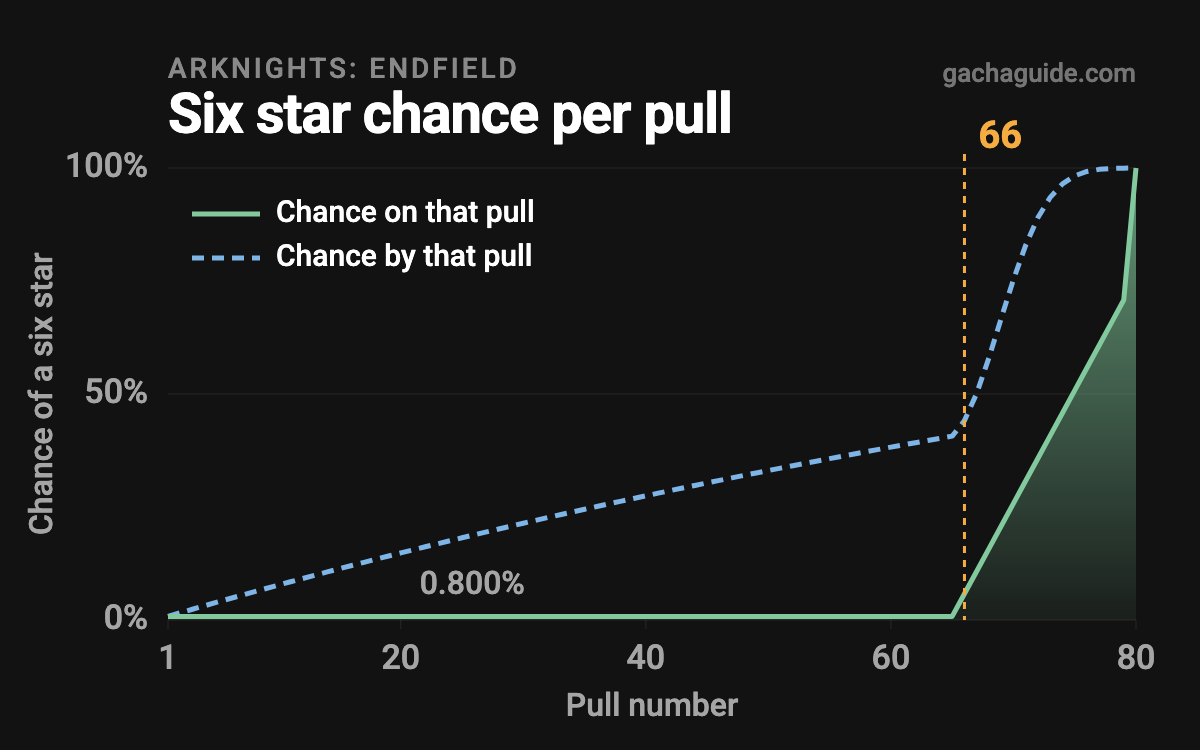
See it in action
- Arknights: Endfield pull simulator - Yvonne
Switch to Pull, then press Pull x10.
- How many pulls for Yvonne? Endfield pity and the 120 guarantee
Detailed breakdown below
Our other deep dives all answer the same question, which is where a curve came from. This one can't, because Endfield just tells you the curve. So it does three other things instead. The first is the useful one.
What sixty pulls actually buys
The long run rate works out to one six star per 53.9 pulls, so 60 pulls should be about one, give or take. It's 0.48.
That's not a rounding problem, it's what a flat rate and a cliff do to a short budget. The first 65 pulls are all 0.8% and nothing else, so inside that window your expected count is exactly 0.008 times however many pulls you have, and none of the pity you keep hearing about applies to you yet. Soft pity is real and at 60 pulls it just isn't for you.
What a budget actually buys, from zero pity
| Pulls | Six stars you should expect | At the long run rate | Short by |
|---|---|---|---|
| 30 | 0.240 | 0.557 | 56.9% |
| 60 | 0.480 | 1.113 | 56.9% |
| 90 | 1.379 | 1.670 | 17.4% |
| 120 | 1.755 | 2.226 | 21.2% |
| 200 | 3.238 | 3.711 | 12.7% |
| 400 | 7.015 | 7.421 | 5.5% |
| 4,000 | 73.813 | 74.213 | 0.5% |
We already write about this effect on the Genshin page, where it comes to 6.0% over 400 wishes. It gets much worse the smaller your budget is, and it isn't special to Endfield either - at 60 pulls every game we model is short by somewhere between 50% and 63%, and Endfield's 56.9% sits in the middle of that. What makes it worth a section here is that the numbers on this page are the ones you would be budgeting against.
The 30 pull and 60 pull rows are the same 56.9%, exactly, which is the flat region giving itself away. And the gap doesn't shrink steadily either: it improves to 17.4% at 90 pulls and then gets worse again at 120. That's the pity cycle beating against the size of your budget, and it's the sort of thing that looks like a spreadsheet bug right up until you work out why.
If you take one number away from this page, take that one. 30,000 Oroberyl is 60 pulls, and that's not one operator, it's about half of one.
Why the worst case is 120
Lose the 50/50 at pull 79, and the next six star is guaranteed to be the rate-up operator - but it might take another 80 pulls to arrive. 80 plus 80 is 160, and that's the worst case a lot of calculators quote.
It isn't the worst case though, because the 120 guarantee gets there first. Once you're 120 pulls into a banner you have the operator.
Pulls to the rate-up operator
| Ignoring the 120 rule | With it | |
|---|---|---|
| Mean | 80.85 | 76.90 |
| Median | 72 | 72 |
| 75th percentile | 113 | 113 |
| 90th percentile | 139 | 120 |
| 95th percentile | 142 | 120 |
| Worst case | 160 | 120 |
About 22.6% of players reach pull 120 without the operator, and for every one of them the guarantee is the thing that ends it. That's more than one player in five, so it isn't a rare case. Leaving it out makes the 90th percentile wrong by 19 pulls and the worst case wrong by a third.
We've made this exact mistake before, with Epitomized Path on the Genshin weapon banner, and shipped it for two years. So we're a bit sensitive about it.
What Endfield is straight up about
There's a question we've been chewing on for a while: does landing a top rarity item reset your counter for the tier below it? On the Zenless page we argue our way into yes, and it takes most of a page, because the only evidence there is that their published numbers don't add up otherwise.
Endfield's wording is better placed. It says that if a five star "or above" hasn't appeared in 9 consecutive pulls then the 10th is guaranteed, and there the "or above" sits on what starts the counter and not on what the guarantee hands you. That's the distinction the Zenless wording never quite makes.
It's still one preposition on a community wiki though, and unlike Zenless there's no published average here to check it against. So we model the reset, and we say we model it. The two readings differ by 0.7 percentage points, so it isn't a rounding choice.
The odd part is that GGanalysis says in its own source that a six star appears to reset the five star pity, and then ships a model that doesn't do it. So on this one mechanic we think we're doing something nobody else does, which is either a good sign or a bad one, and we'd rather say so than not.
The rule that does not add up
Endfield says that on a guaranteed pull the chance of a five star is 99.2% and a six star 0.8%. That can't be right in general. The two counters run independently, so your five star guarantee can land on a pull where your six star counter is sitting at 76, and at 76 the published six star rate is 55.8% and not 0.8%.
Our engine actually gets this right without being asked, because it draws one number and gives the lower tier only what the higher tier left. So we model the six star at whatever its curve says and the five star at the rest. We're pointing at it rather than quietly patching over it, since it's Gryphline's sentence and not ours.
What is not settled
Published, and we don't argue with it: the base rates, the whole six star curve, both guarantees, the 120 rule and the 50/50.
Ours: that a six star clears the five star counter, and the even split of anything we don't otherwise pin down. Also every number on this page that's an average or a percentile, because Endfield doesn't publish a long run rate at all - which is unusual, and for once it doesn't really cost us anything, since we have the curve those numbers come from.
On the other four games we can check ourselves against a figure the operator publishes, and here we can't. What we check instead is the transcription, against every rate they do print, which is fifteen numbers against one - so arguably a better check than the one we're missing.
Open: whether the four star operators should be on this site at all. They're 84.7% of pulls and they're named characters, and right now they're nowhere.
Sources
[1] Arknights: Endfield Wiki (CC BY-SA)
[2] GGanalysis, a gacha probability library (MIT)